

2026-09-30 14:37
The 2026 Beijing Top 100 Private Enterprises list was unveiled on Sept 18, with JD.com, Lenovo, Xiaomi, DiDi and Meituan included on the main list.
There are also three sub-lists. Baidu, Kuaishou, Zhipu AI and Li Auto were listed among the top 100 science and technology innovation enterprises. Pop Mart, TAL Education and BlueFocus were named in the top 100 cultural industry enterprises. InnoCare and Waterdrop entered the top 100 specialized and innovative enterprises.
Notably, Beijing also added a new list this year, which is the Top 100 Future Industry Pioneers list. Deepexi, DP Technology, QBoson and HyperStrong were included in the newly-added list.
The Top 100 Private Enterprises list program has run for nine consecutive years. This year's framework follows a “1+3+1” structure, with one main list, three sub-lists and the new addition.
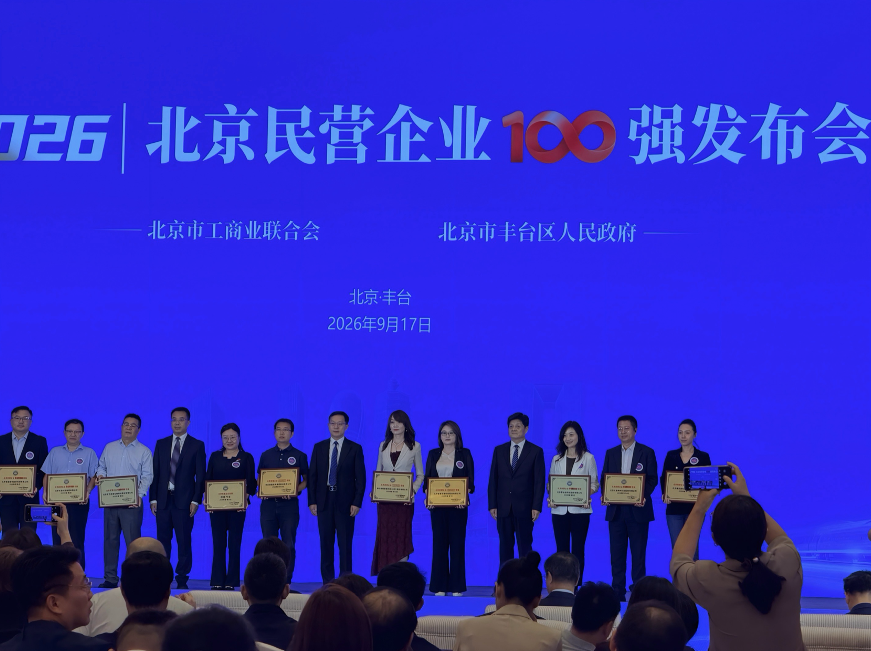
Representatives at the 2026 Top 100 Beijing Private Enterprises release ceremony in Beijing.[Photo/invest.beijing.gov.cn]
Total revenue of the Top 100 Private Enterprises main list added up to 5.89 trillion yuan, up 11.98 percent. Total assets hit 15.88 trillion yuan, up 5.73 percent. Both figures were record highs. Twenty-one main-list companies were included in the 2026 Fortune China 500, and six made the Fortune Global 500. About 83 percent relied mainly on independent research and development for key technologies. Seventy percent led or took part in setting 4,027 standards. Seventy-five percent used digital transformation to cut costs and improve efficiency. Eighty-four percent carried out green and low-carbon transformation. Sixty-nine percent invested in strategic emerging industries. Eighty-two percent expanded in the Beijing-Tianjin-Hebei region, and 65 percent conducted international business.
The top 100 science and technology innovation enterprises reported 2.87 trillion yuan in revenue, up 16.70 percent. Their R&D spending reached 207.94 billion yuan, up 19.32 percent. Ninety-five percent invested in strategic emerging industries, 71 percent in future industries and 64 percent in core digital economy fields. Ninety percent cooperated with universities, research institutes and State-owned enterprises. Sixty-four percent undertook national major science and technology projects in the past three years.
The top 100 cultural industry enterprises saw revenue reach 508.09 billion yuan, up 20.95 percent, passing 500 billion yuan for the first time. Their total profit reached 82.07 billion yuan, up 88.28 percent. Put together, they have won 84 national and provincial science and technology awards and held 74,900 valid intellectual property rights, up 47.38 percent. Eighty-seven percent explored new cultural formats, and 40 percent developed mature culture-tourism models.
The top 100 specialized and innovative enterprises reported 58.85 billion yuan in revenue and 13.27 billion yuan in profit, up 22.17 percent. Ninety-six percent invested in strategic emerging industries, and 71 percent entered future industries. All key technologies came from independent research and development. All in all, they have undertaken 169 national and provincial major science and technology projects. Seventy percent were recognized as national “little giant” enterprises. More than 90 percent of their leading products addressed bottleneck links or filled domestic gaps.