

2026-04-01 15:55
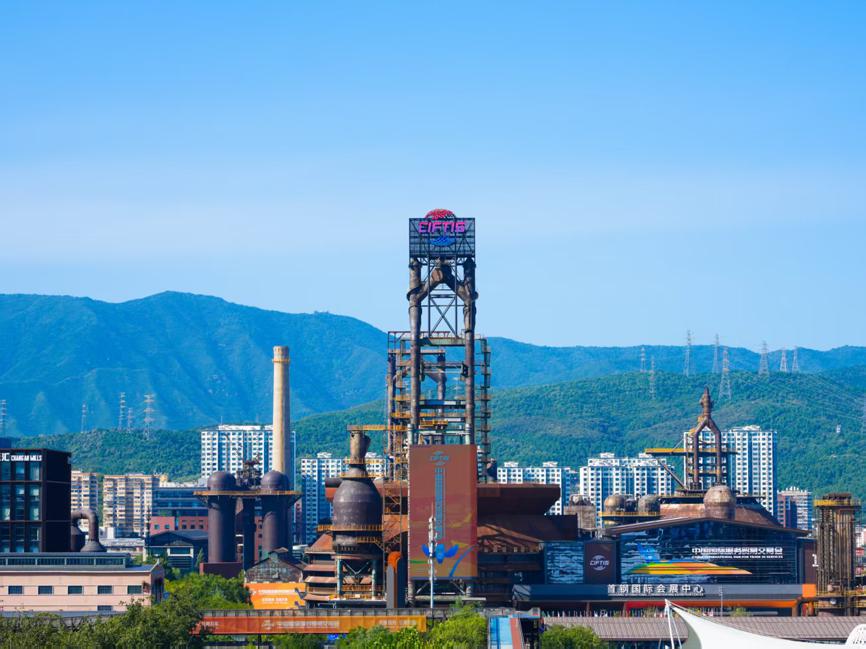
A glance at the Shougang Park, the permanent venue of the China International Fair for Trade in Services. [Photo provided to chinadaily.com.cn]
The Beijing Municipal Commerce Bureau has recently released The Three-Year Action Plan for High-Quality Development of Beijing's Convention and Exhibition Industry (2026-2028), unveiling a series of measures in a bid to build the capital city into a high-energy hub for conventions and exhibitions.
According to the document, Beijing plans to foster two to three convention and exhibition enterprise clusters by the year of 2028, creating an industry echelon comprising two to three enterprises with annual revenues exceeding 1 billion yuan ($146.34 billion), 20 to 30 enterprises with annual revenues exceeding 100 million yuan, and more than 100 enterprises with annual revenues exceeding 10 million yuan by that time, thereby forming a new high-quality development pattern for the convention and exhibition industry that is in line with the city's strategic positioning as the national capital.
National Leader in Exhibition Sector
As an important component of the modern service sector, the convention and exhibition industry has a powerful multiplier effect, effectively driving the coordinated development of trade, culture, tourism, technology, and many other sectors. Statistics show that Beijing has consistently ranked first in the nation in terms of exhibition market share, accounting for nearly a quarter of the national total.
In the past year, Beijing's convention and exhibition industry has witnessed vigorous growth. The city has provided "one-on-one" services to eleven key venues, established a dedicated service steward mechanism for key exhibition venues, and guided venues to provide full-process approval and filing assistance services for event organizers. Venue functions have also been continuously improved. Data indicate that there are currently eleven professional exhibition venues in the city with an area of more than 10,000 square meters, offering a total indoor and outdoor exhibition area of 838,800 square meters.
Simultaneously, the renovation and upgrading of existing exhibition venues are moving forward. For example, the Shougang Park Convention & Exhibition Town, which aims to become the permanent site of the China International Fair for Trade in Services (CIFTIS), has developed distinctive scenarios that blend exhibitions with technology, culture, and sports. The Beijing Exhibition Center, for its part, has integrated catering, performances, baking, hotel services, and retail.
The Influence of the "Four Platforms"
According to the plan, the spatial layout and venue functions of Beijing's convention and exhibition industry will have been significantly optimized by 2028, with two to three distinctive exhibition industry clusters. The international operational capacity and concentration of exhibition market players will be markedly strengthened, leading to the formation of an enterprise echelon consisting of two to three enterprises with annual revenues exceeding 1 billion yuan, 20 to 30 enterprises with annual revenues exceeding 100 million yuan, and more than 100 enterprises with annual revenues exceeding 10 million yuan by that time.
In terms of brand influence, the city will focus on its leading industries, areas of strength, emerging industries, and industries of the future to cultivate a series of specialized, flagship exhibition programs that lead the industry and enjoy global recognition. The impact and influence of the city's "four platforms"—the CIFTIS, the Zhongguancun Forum, the Financial Street Forum, and the Beijing Culture Forum—will be significantly elevated.
Exhibitor participation and public visits will both become more convenient. The plan outlines support for the development of new exhibition and service models, the improvement of "one-stop" integrated services, and the facilitation of multi-currency payments and customs clearance. A service guarantee system for the exhibition industry will be developed to the highest standard, centered on the concept of a "15-minute convention and exhibition life circle."
A Combination of 24 Concrete Measures
The plan puts forward 24 concrete measures to advance Beijing's goal of building a high-energy convention and exhibition city that faces the world and the future.
The city will guide key venues to pursue differentiated development and complementary functions, expand and upgrade surrounding spaces, and create exhibition industry clusters, with a focus on developing the Beijing (Shunyi) International Exhibition Industry Cluster and the Shougang Park Convention & Exhibition Town. Cross-regional venue collaboration will be leveraged to drive the development of small and medium-sized venues and distinctive spaces, making full use of exhibition and conference facilities, hotel resources, and retail, entertainment, and tourism amenities.
The city will further facilitate the internationalization of market players. Focusing on key industry players where Beijing has notable strengths—including venue operators, exhibition organizers, comprehensive service providers, and international organizations—the city will enhance the global competitiveness of enterprises and use the global networks of international organizations to attract exhibitors.
The city will also launch a series of "Convention & Exhibition+" integrated development initiatives, including the creation of new integrated consumption scenarios, the development of citywide "ticket-stub economy" models, the expansion of "exhibition + investment" activities, and the positioning of Beijing as a premier launch hub for new products.
The plan encourages all districts to leverage major commercial districts, distinctive commercial streets, scenic spots and tourist attractions, and urban public spaces to provide value-added experiences and foster a consumption-friendly atmosphere, while setting up investment promotion service zones at key exhibitions.