

2025-02-24 16:55
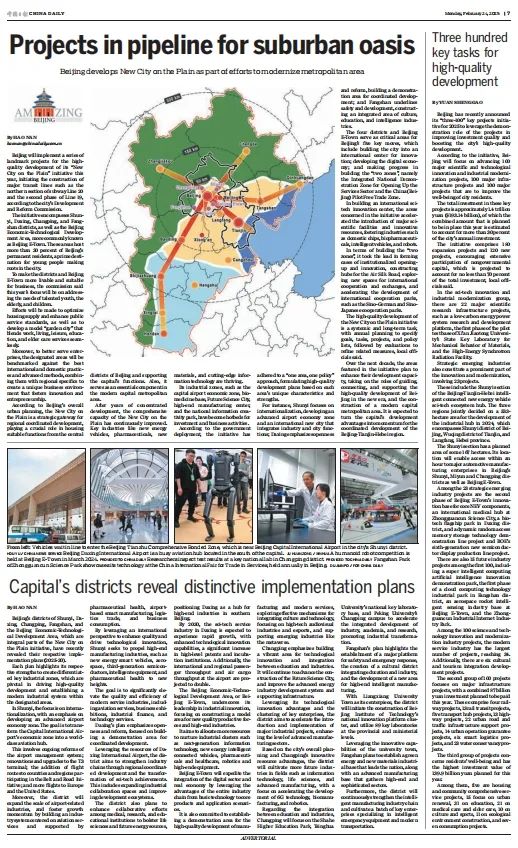
Beijing will implement a series of landmark projects for the high-quality development of its "New City on the Plain" initiative this year, initiating the construction of major transit lines such as the northern section of subway Line 20 and the second phase of Line 19, according to the city's Development and Reform Commission.
The initiative encompasses Shunyi, Daxing, Changping, and Fangshan districts, as well as the Beijing Economic-Technological Development Area, more commonly known as Beijing E-Town. These areas host more than 30 percent of Beijing's permanent residents, a prime destination for young people making roots in the city.
To make the districts and Beijing E-Town more livable and suitable for business, the commission said this year's focus will be on addressing the needs of talented youth, the elderly, and children.
Efforts will be made to optimize housing supply and enhance public service standards, as well as to develop a model "garden city" that blends work, living, leisure, education, and elder care services seamlessly.
Moreover, to better serve enterprises, the designated areas will be benchmarked against the best international and domestic practices and advanced methods, combining them with regional specifics to create a unique business environment that fosters innovation and entrepreneurship.
According to Beijing's overall urban planning, the New City on the Plain is a strategic gateway for regional coordinated development, playing a crucial role in housing suitable functions from the central districts of Beijing and supporting the capital's functions. Also, it serves as an essential component in the modern capital metropolitan area.
After years of concentrated development, the comprehensive capacity of the New City on the Plain has continuously improved. Key industries like new energy vehicles, pharmaceuticals, new materials, and cutting-edge information technology are thriving.
Its industrial zones, such as the capital airport economic zone, biomedicine base, Future Science City, high-end manufacturing center, and the national information creativity park, have become hotbeds for investment and business activities.
According to the government deployment, the initiative has adhered to a "one area, one policy" approach, formulating high-quality development plans based on each area's unique characteristics and strengths.
For instance, Shunyi focuses on internationalization, developing an advanced airport economy zone and an international new city that integrates industry and city functions; Daxing emphasizes openness and reform, building a demonstration area for coordinated development; and Fangshan underlines safety and development, constructing an integrated area of culture, education, and intelligence industries.
The four districts and Beijing E-Town serve as critical areas for Beijing's five key moves, which include building the city into an international center for innovation; developing the digital economy; and making progress in building the "two zones", namely the Integrated National Demonstration Zone for Opening Up the Services Sector and the China (Beijing) Pilot Free Trade Zone.
In building an international sci-tech innovation center, the areas concerned in the initiative accelerated the introduction of major scientific facilities and innovative resources, fostering industries such as domestic chips, biopharmaceuticals, intelligent vehicles, and robots.
In terms of building the "two zones", it took the lead in forming cases of institutionalized opening-up and innovation, constructing hubs for the Air Silk Road, exploring new spaces for international cooperation and exchanges, and accelerating the development of international cooperation parks, such as the Sino-German and Sino-Japanese cooperation parks.
The high-quality development of the New City on the Plain initiative is a systemic and long-term task, with annual planning to specify goals, tasks, projects, and policy lists, followed by evaluations to refine related measures, local officials said.
Over the next decade, the areas featured in the initiative plan to enhance their development capacity, taking on the roles of guiding, connecting, and supporting the high-quality development of Beijing in the new era, and the construction of a modern capital metropolitan area. It is expected to turn the capital's development advantages into momentum for the coordinated development of the Beijing-Tianjin-Hebei region.
Capital's districts reveal distinctive implementation plans
Beijing's districts of Shunyi, Daxing, Changping, Fangshan, and the Beijing Economic-Technological Development Area, which are integral parts of the New City on the Plain initiative, have recently revealed their respective implementation plans (2025-30).
Each plan highlights its respective strengths to create differentiated key industrial zones, which are pivotal in driving high-quality development and establishing a modern industrial system within the designated areas.
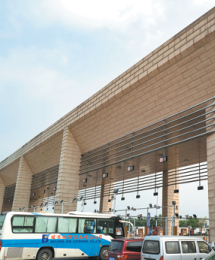
▲Vehicles wait in line to enter the Beijing Tianzhu Comprehensive Bonded Zone, which is near Beijing Capital International Airport in the city's Shunyi district. HOU YU/CHINA NEWS SERVICE
In Shunyi, the focus is on internationalization, with an emphasis on developing an advanced airport economy zone. The goal is to transform the Capital International Airport's economic zone into a world-class aviation hub.
This involves ongoing reforms of the airport management system; renovations and upgrades to the T3 terminal; the addition of flight routes to countries and regions participating in the Belt and Road Initiative; and more flights to Europe and the United States.
Moreover, the district will expand the scale of airport-related industries, and foster growth momentum by building an industry system centered on aviation services and supported by pharmaceutical health, airport-based smart manufacturing, logistics trade, and business consumption.
By leveraging an international perspective to enhance quality and drive technological innovation, Shunyi seeks to propel high-end manufacturing industries, such as new energy smart vehicles, aerospace, third-generation semiconductors, intelligent equipment, and pharmaceutical health to new heights.
The goal is to significantly elevate the quality and efficiency of modern service industries, including aviation services, business exhibitions, industrial finance, and technology services.
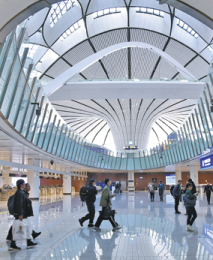
▲Beijing Daxing International Airport is a busy aviation hub located in the south of the capital. JU HUANZONG/XINHUA
Daxing's plan emphasizes openness and reform, focused on building a demonstration area for coordinated development.
Leveraging the resources of Daxing International Airport, the district aims to strengthen industry chains through regional coordinated development and the transformation of sci-tech achievements. This includes expanding industrial collaboration spaces and improving development ecosystems.
The district also plans to enhance collaborative efforts among medical, research, and educational institutions to bolster life sciences and future energy sources, positioning Daxing as a hub for high-end industries in southern Beijing.
By 2030, the sci-tech service industry in Daxing is expected to experience rapid growth, with enhanced technological innovation capabilities, a significant increase in high-level patents and incubation institutions. Additionally, the international and regional passenger throughput and air cargo throughput at the airport are projected to double.
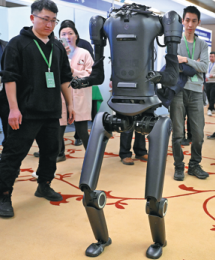
▲A humanoid robot competition is held at Beijing E-Town in March 2024. CHINA DAILY
The Beijing Economic-Technological Development Area, or Beijing E-Town, underscores its leadership in industrial innovation, focusing on constructing a model area for new quality productive forces and high-end industries.
It aims to allocate more resources to nurture industrial clusters such as next-generation information technology, new energy intelligent connected vehicles, pharmaceuticals and healthcare, robotics and high-end equipment.
Beijing E-Town will expedite the integration of the digital sector and real economy by leveraging the advantages of the entire industry chain from basic technology to core products and application scenarios.
It is also committed to establishing a demonstration area for the high-quality development of manufacturing and modern services, exploring effective mechanisms for integrating culture and technology, focusing on high-tech audiovisual industries and esports, and supporting emerging industries like the metaverse.
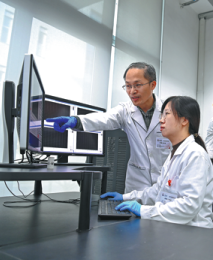
▲Researchers inspect test results at a key national lab in Changping district. CHINA DAILY
Changping emphasizes building a vibrant area for technological innovation and integration between education and industries. It will continue to advance the construction of the Future Science City, and improve the advanced energy industry development system and supporting infrastructure.
Leveraging its technological innovation advantages and the clustering of key enterprises, the district aims to accelerate the introduction and implementation of major industrial projects, enhancing the level of advanced manufacturing sectors.
Based on the city's overall planning and Changping's innovative resource advantages, the district will cultivate more future industries in fields such as information technology, life sciences, and advanced manufacturing, with a focus on accelerating the development of 6G technology, biomanufacturing, and robotics.
Regarding the integration between education and industries, Changping will focus on the Shahe Higher Education Park, Tsinghua University's national key laboratory base, and Peking University's Changping campus to accelerate the integrated development of industry, academia, and research, promoting industrial transformation.
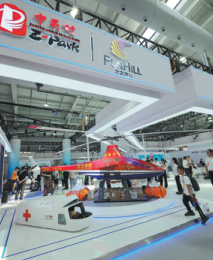
▲Fangshan Park of Zhongguancun Science Park showcases its technology at the China International Fair for Trade in Services, held annually in Beijing. DU JIANPO/FOR CHINA DAILY
Fangshan's plan highlights the establishment of a major platform for safety and emergency response, the creation of a cultural district integrating education and industry, and the development of a new area for high-end intelligent manufacturing.
With Liangxiang University Town as its centerpiece, the district will initiate the construction of Beijing Institute of Technology's national innovation platform cluster, and utilize 89 key laboratories at the provincial and ministerial levels.
Leveraging the innovative capabilities of the university town, Fangshan plans to establish a green energy and new materials industrial base that leads the nation, along with an advanced manufacturing base that gathers high-end and sophisticated sectors.
Furthermore, the district will continuously strengthen the intelligent manufacturing industry chain and cultivate a batch of key enterprises specializing in intelligent emergency equipment and modern transportation.
(Source: Chinadaily)