

2026-05-12 10:35
The 28th China Beijing International High-Tech Expo (CHITEC) concluded on May 10. The three-day event brought together over 800 enterprises and institutions, and saw the releasing of 148 items of scientific and technological achievements. It attracted more than 70,000 onsite visitors from 72 countries and regions, with online views exceeding half a million.
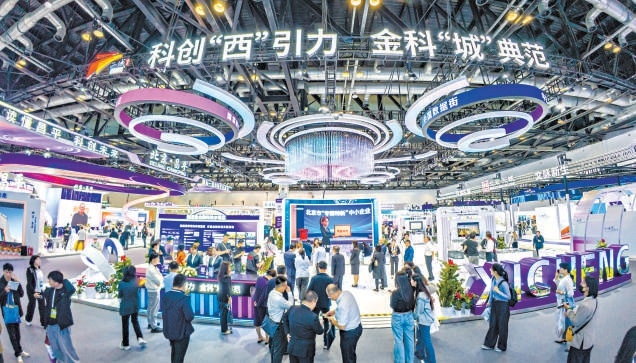
CHITEC attracts more than 70,000 onsite visitors from 72 countries and regions. [Photo/Beijing Daily]
Visitors Experience Cutting-Edge Technologies
The expo has for the first time set up a science popularization industry zone. It featured the OBVerse holographic cabin by Guoshu Technology (Beijing) Co Ltd, which projects visitors' digital images in seconds and allows virtual try ons of traditional Miao, Zhuang and Mongolia costumes. The device delivers glasses-free 3D visuals and AI-powered interaction, and has already used in various sectors such as healthcare, education, culture, and tourism.
At the China Academy of Aerospace System Science and Engineering booth, visitors lined up for interstellar cycling and VR simulations of space station life. "Experiencing space life feels far more vivid than reading about it in textbooks," said high school student Lin while trying a "space motorcycle" simulator.
At the booth of the Capital Cultural Technology Group, children wearing VR headsets participated in a real-time VR fishing competition, fully engaged in the interactive experience.
The agricultural machinery exhibition area also became a popular attraction for families. Children climbed onto Changwo Agricultural Machinery's "King Kong" tractor, which has already entered overseas markets.
Promoting Cooperation
CHITEC served as both a showcase and a cooperation platform. A total of 37 business matchmaking events led to 57 signed projects valued at 590 million yuan.
Integration of innovation and industrial chains transformed booths into dynamic negotiation spaces, particularly for AI, fintech, embodied intelligence, robotics, and scenario-based applications. This accelerated the transformation of exhibits into marketable products and technologies into commercial solutions.
During the expo, Beijing also hosted the 2026 Beijing Green Innovation Technology Exchange Conference. The conference led to the signing of four cooperative projects in biomass gasification resource utilization, low-carbon intelligent upgrading projects in Thailand's SCG business sector, and smart heating transformation, totaling 55.8 million yuan.
Several international trade and investment events were also held, including the Conference on Emerging Technologies and Future Industries Development, the Conference on Technological Development of the Food-Medicine Homology Industry, the China-Europe Dual Carbon Practice Matchmaking Conference, and the Beijing-ASEAN Sci-Tech Industry Promotion and Matchmaking Conference.
Representatives discussed dual-carbon policies, corporate compliance, and zero-carbon industrial park development to support Beijing's international green economy benchmark goals.
"Technology drives development. It's also the most dynamic area for cooperation between Beijing and ASEAN," said Bo Shanglang, president of the ASEAN Economic and Trade Promotion Association. He encouraged enterprises to seize opportunities from regional integration.
Integrating Exhibitions with Consumption
This year's expo emphasized the integration of exhibitions with culture, commerce, tourism, and sports to boost urban consumption.
The inaugural exhibition-commerce integrated consumption season included promotions from over 120 businesses in the Asian Games Village–Olympic Center area. Exhibitors and visitors could enjoy discounts on dining, shopping, leisure, and accommodation via the "Polaris" mini-program using expo credentials or QR codes.
The initiative created a closed-loop consumption model linking exhibitions, experiences and spending, boosting commercial activity in surrounding districts and driving growth in the catering, hospitality, and retail sectors.